Industry News
How Does Polyacrylamide (PAM) Work in Wastewater Treatment?
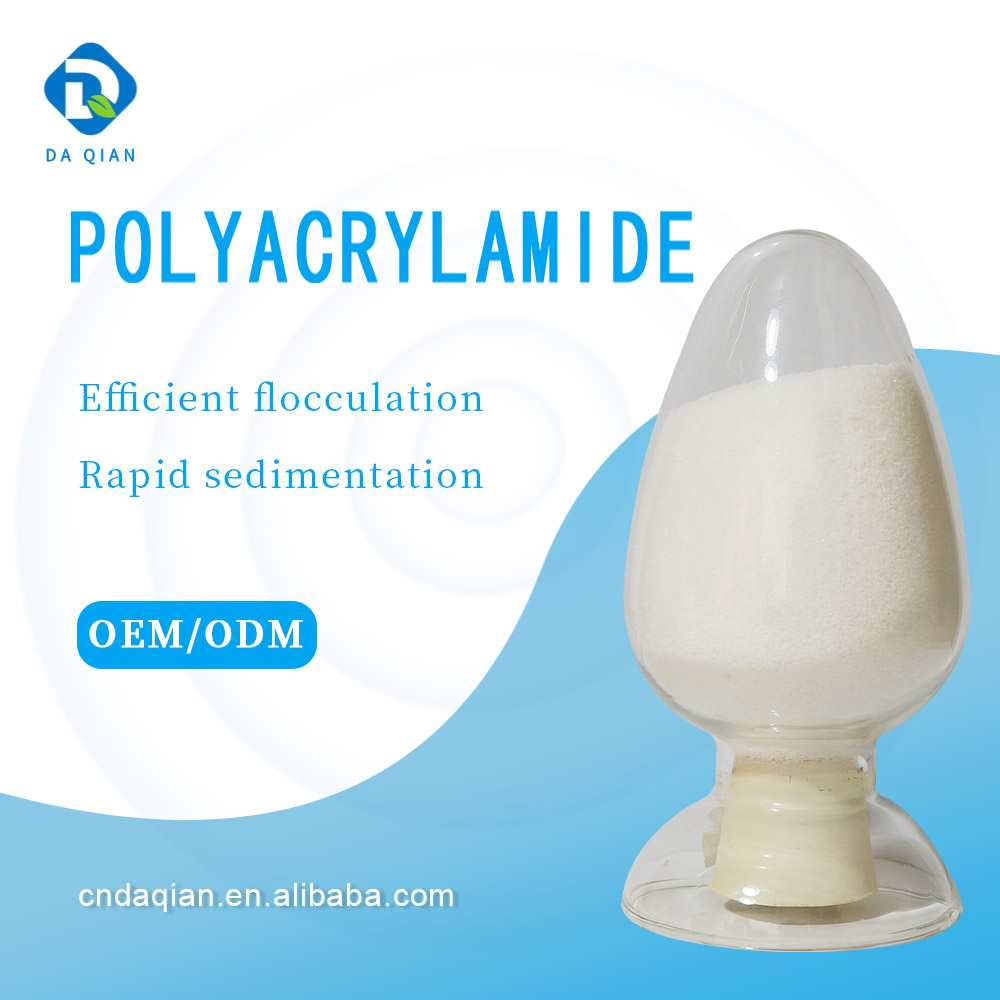
Polyacrylamide (PAM) is one of the most widely used flocculants in water and wastewater treatment. It helps remove suspended solids, reduce turbidity, and improve solid-liquid separation, making wastewater treatment more efficient and cost-effective.
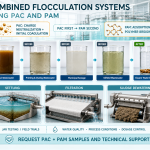
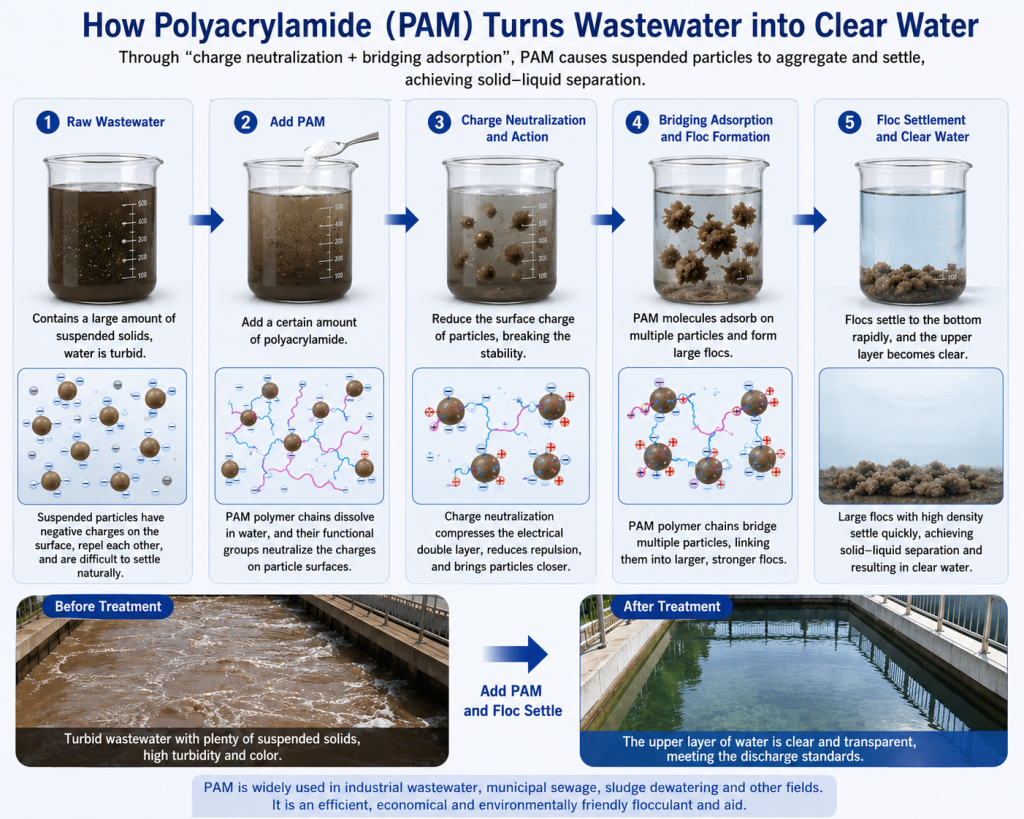
Step 1: Raw Wastewater
Industrial and municipal wastewater often contains a large number of suspended particles. These tiny particles usually carry negative surface charges, causing them to repel each other and remain evenly dispersed in water. As a result, the water appears cloudy and particles settle very slowly.
Step 2: Adding Polyacrylamide (PAM)
When an appropriate amount of PAM is added to the wastewater, its long polymer chains dissolve rapidly and begin interacting with suspended particles.
Depending on the wastewater characteristics, different types of PAM (anionic, cationic, or nonionic) can be selected to achieve the best treatment performance.
Step 3: Charge Neutralization
One of the key mechanisms of PAM is charge neutralization.
The functional groups on the polymer reduce the surface charges of suspended particles, weakening the electrostatic repulsion between them. Once the repulsive force decreases, particles can move closer together and begin to aggregate.
Step 4: Bridging Adsorption and Floc Formation
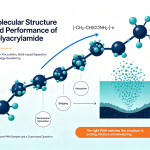
Another important mechanism is bridging adsorption.
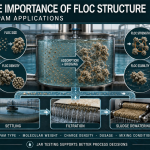
The long molecular chains of PAM attach to multiple particles simultaneously, creating bridges that connect them into larger and denser flocs. These flocs are much easier to separate from water than individual fine particles.
This process significantly improves the efficiency of sedimentation and clarification.
Step 5: Floc Settlement and Clear Water
As the flocs become larger and heavier, they settle rapidly to the bottom of the tank under gravity.
The upper layer of water becomes clear and transparent, while the settled sludge can be removed for further treatment or disposal. This efficient solid-liquid separation is the foundation of many wastewater treatment processes.
Applications of Polyacrylamide
Polyacrylamide is widely used in various industries, including:
- Municipal wastewater treatment
- Industrial wastewater treatment
- Mining and mineral processing
- Paper manufacturing
- Textile and dyeing industries
- Sludge dewatering
- Coal washing
- Oil and gas production
By selecting the appropriate molecular weight and ionic type, PAM can be customized to meet different treatment requirements.
Why Choose Polyacrylamide?
Polyacrylamide offers several important advantages:
- Fast floc formation and sedimentation
- Improved water clarity
- Enhanced solid-liquid separation
- Lower operating costs
- Reduced sludge handling requirements
- High efficiency across a wide range of industrial applications
With proper product selection and dosage optimization, PAM provides a reliable and economical solution for wastewater treatment systems around the world.
Conclusion
Polyacrylamide transforms wastewater into clearer water through two primary mechanisms: charge neutralization and bridging adsorption. By promoting particle aggregation and accelerating sedimentation, PAM helps achieve efficient flocculation and solid-liquid separation, making it an indispensable chemical in modern water treatment operations.