Company News
What Determines the Water Absorption Capacity of SAP?
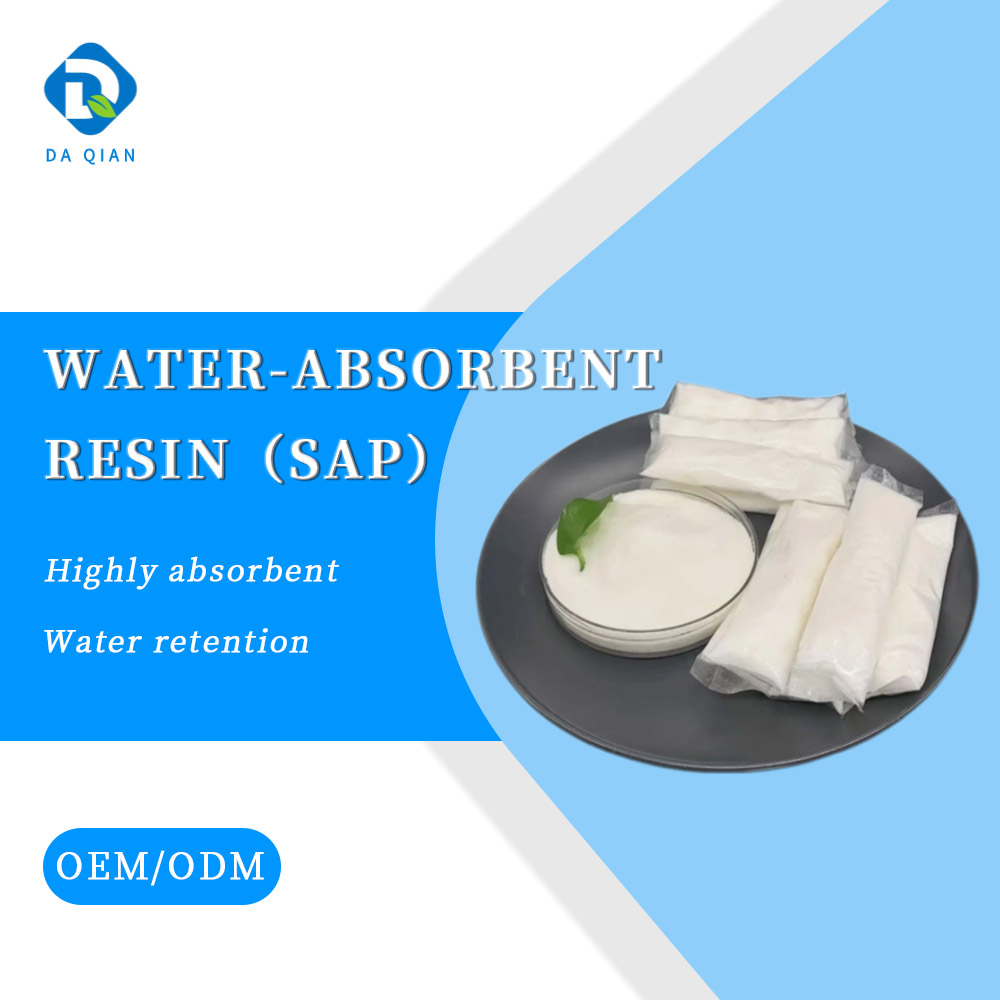
Water Absorption Capacity is one of the most important performance indicators of Super Absorbent Polymer (SAP).
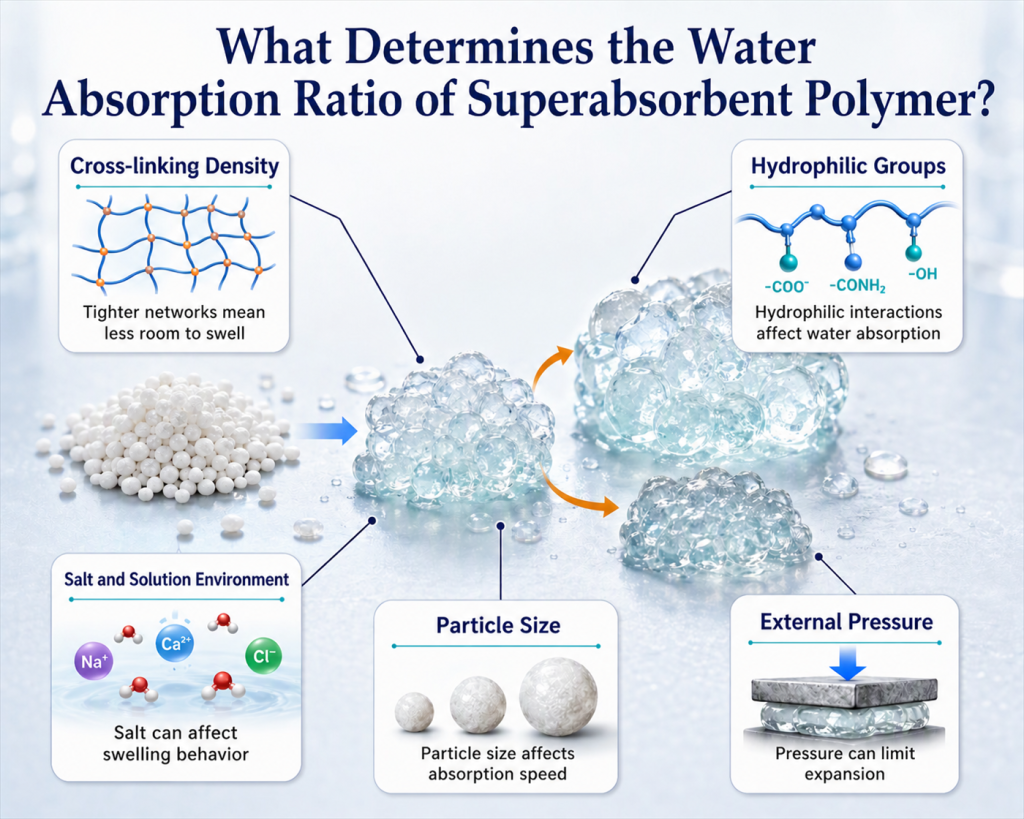
Simply put, it refers to the amount of water absorbed by SAP compared with its own weight. However, different SAP products can have significantly different absorption capacities due to factors such as polymer structure, cross-linking density, water quality, particle size, and testing conditions.
1. Polymer Structure
The molecular structure of SAP is an important factor affecting its absorption performance.
SAP contains hydrophilic groups that attract and bind water molecules. Differences in polymer structure can affect the number and distribution of these groups, resulting in different absorption capacities.
2. Cross-Linking Density
SAP has a three-dimensional cross-linked polymer network.
If the cross-linking density is too high, the polymer network may restrict swelling and reduce water absorption.
If the cross-linking density is too low, SAP may absorb more water but have weaker gel strength and structural stability.
Therefore, an appropriate cross-linking level needs to balance absorption capacity and gel strength.
3. Water Quality and Salt Concentration
SAP does not absorb the same amount of water under all conditions.
It generally shows higher absorption in pure water or low-ion-concentration environments. In water containing higher levels of salts or ions, its absorption capacity can decrease significantly.
Therefore, the absorption capacity measured in laboratory tests may not be the same as the performance under actual application conditions.
4. Particle Size
Particle size can also affect the absorption process.
Smaller particles generally absorb water more quickly, while different particle-size distributions can affect overall absorption performance and gel formation.
Therefore, when selecting SAP, it is important to consider not only absorption capacity but also particle size and absorption rate.
5. Testing Conditions
Different testing methods and conditions can also produce different absorption results.
Factors may include:
- Water quality
- Absorption time
- Temperature
- Solid-to-liquid ratio
- Testing method
For this reason, different SAP products should ideally be compared under the same testing conditions.
Does Higher Absorption Capacity Always Mean Better SAP?
Not necessarily.
Absorption capacity is only one of the important performance indicators of SAP.
When selecting a product, buyers should also consider:
✅ Absorption Capacity
✅ Absorption Rate
✅ Gel Strength
✅ Water Retention
✅ Particle Size
✅ Application Conditions
The best SAP is not necessarily the product with the highest absorption capacity. Instead, it should be the product whose overall performance matches the specific application requirements.
Conclusion
The water absorption capacity of SAP is influenced by multiple factors, including polymer structure, cross-linking density, water quality, particle size, and testing conditions.
Understanding these factors helps buyers evaluate SAP performance more accurately and select the right product for their specific requirements.
Looking for SAP with consistent absorption performance? Contact us for product specifications and technical support.