Company News
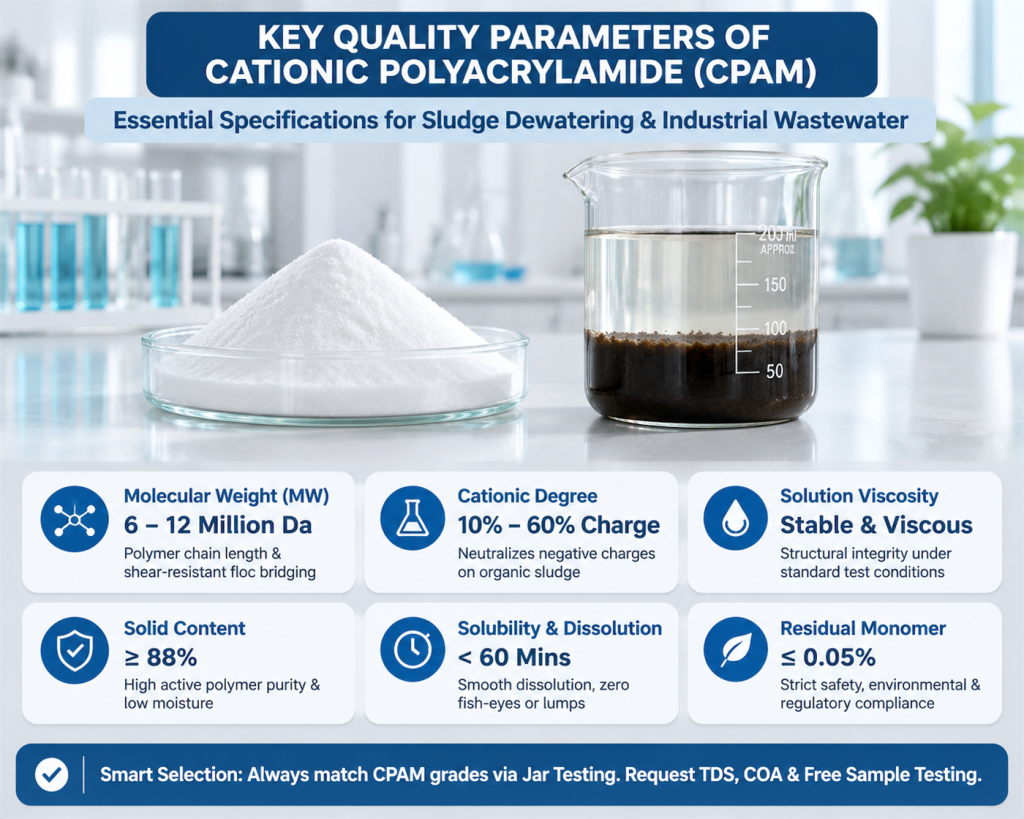
What Are the Key Quality Parameters of Cationic Polyacrylamide (CPAM)?
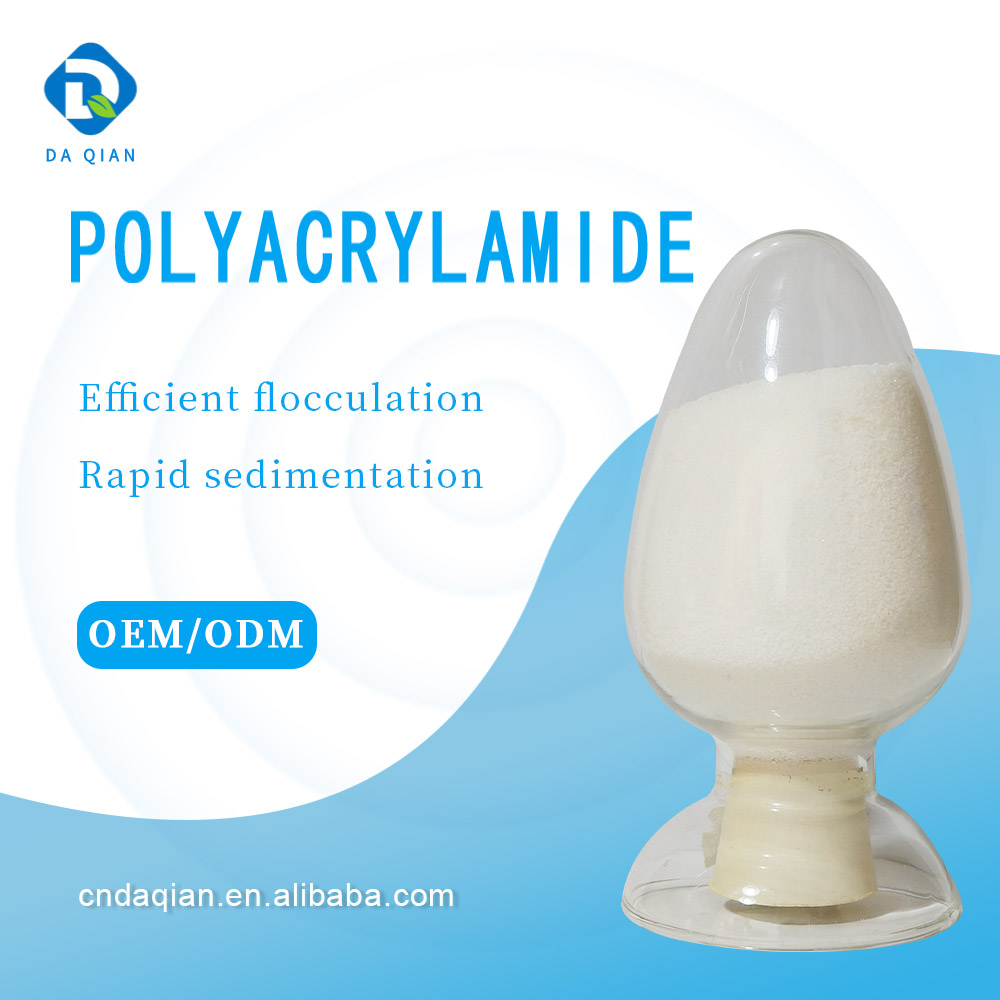
Cationic Polyacrylamide (CPAM) is a widely used polymer flocculant in municipal wastewater treatment, industrial wastewater treatment, sludge thickening and dewatering, papermaking, and other solid-liquid separation processes.
Different CPAM grades can deliver different treatment results, even when their appearance is similar. Parameters such as molecular weight, cationic degree, and solubility can all influence floc formation and sludge dewatering performance.
So, what are the most important quality parameters to consider when selecting cationic polyacrylamide?
🔹 1. Molecular Weight
Molecular weight is one of the important parameters affecting CPAM performance.
It influences polymer chain length and adsorption-bridging behavior. In general, higher-molecular-weight polymers have longer chains that can help connect fine particles and form larger flocs.
However, higher molecular weight does not always mean better performance. Different sludge characteristics, treatment equipment, and operating conditions require different molecular weight ranges.
Selection Tip: Choose the appropriate molecular weight based on sludge properties, floc formation, and dewatering equipment. Laboratory testing is recommended.
🔹 2. Cationic Degree
Cationic degree is a key performance parameter of cationic polyacrylamide. It generally describes the proportion or content of cationic groups in the polymer, depending on the product specification and test method.
These positively charged groups interact with negatively charged suspended particles and sludge surfaces. This interaction can help reduce electrostatic repulsion and promote particle aggregation.
Different cationic degrees may perform differently depending on the characteristics of the wastewater or sludge.
Selection Tip: Consider sludge composition, surface charge, source, and treatment process when selecting cationic degree. A higher cationic degree does not automatically guarantee better flocculation.
🔹 3. Viscosity
Viscosity is another commonly referenced parameter for CPAM solutions.
Under consistent testing conditions, solution viscosity can provide useful information about polymer characteristics and solution behavior.
However, viscosity is affected by several factors, including solution concentration, temperature, dissolution time, testing equipment, and measurement methods.
Therefore, viscosity values from different suppliers should only be compared when the testing conditions are consistent.
Selection Tip: Always check the viscosity value together with its testing conditions instead of using viscosity alone to judge product quality.
🔹 4. Solid Content
Solid content refers to the proportion of solid material in the product and is an important basic quality parameter.
It affects the amount of solid material supplied per unit of product, as well as preparation requirements and transportation costs.
A higher solid content means more solid material per unit weight, but it does not necessarily indicate better flocculation performance.
Selection Tip: Check the solid content stated in the product Technical Data Sheet (TDS), and evaluate it together with actual treatment performance and operating costs.
🔹 5. Solubility and Dissolution Time
Cationic polyacrylamide is usually prepared as an aqueous solution before being added to a treatment system.
Its solubility and dissolution behavior affect preparation efficiency, dosing stability, and daily operation.
Incomplete dissolution may lead to agglomerates, gel-like particles, or uneven solutions, which can interfere with effective application.
Dissolution time depends on product form, particle size, water temperature, mixing intensity, and solution concentration.
Selection Tip: Follow the supplier’s preparation instructions, including powder addition, mixing speed, and maturation time. Avoid adding excessive powder all at once or using unnecessarily intense mixing.
🔹 6. Residual Acrylamide Monomer
Residual acrylamide monomer is an important parameter for CPAM safety and quality control.
Acrylamide monomer is different from polymerized polyacrylamide. Some unreacted monomer may remain in the finished product, so its level needs to be controlled through manufacturing processes and product testing.
For municipal wastewater treatment, sludge treatment, and applications involving environmental discharge, residual monomer levels and relevant regulatory requirements deserve particular attention.
Selection Tip: Request a product test report from your supplier, check the residual acrylamide content, and confirm that the product meets the requirements for its intended application and local regulations.
🔹 7. pH Value
The pH value indicates the acidity or alkalinity of a CPAM solution and is included in some product specifications as a reference parameter.
In practical applications, flocculation performance depends not only on the polymer itself but also on the pH of the wastewater or sludge being treated.
Different pH conditions may influence particle surface charges and polymer interactions.
Selection Tip: Check both the pH of the prepared polymer solution and the pH of the actual wastewater or sludge. Use jar testing to determine suitable operating conditions.
🔹 How to Select the Right CPAM for Different Applications
Different applications require different CPAM characteristics.
- Municipal wastewater treatment: Pay attention to cationic degree, molecular weight, and sludge dewatering performance.
- Industrial wastewater treatment: Consider suspended solids characteristics, wastewater composition, and the treatment process.
- Sludge dewatering: Evaluate floc strength, filtration performance, cake moisture content, and chemical consumption.
- Papermaking: Select the appropriate grade according to fiber, filler, and specific process requirements.
It is important to note that testing methods and conditions for molecular weight, cationic degree, and viscosity may vary among manufacturers. When purchasing CPAM, request a complete TDS (Technical Data Sheet) and COA (Certificate of Analysis), and confirm the test methods used for each parameter.
🔹 Conclusion: Proper Product Selection Matters More Than One Parameter
The quality of cationic polyacrylamide cannot be determined by a single parameter.
Molecular weight, cationic degree, viscosity, solid content, solubility, and residual acrylamide monomer all contribute to its overall application performance.
Before full-scale purchasing and dosing, we recommend conducting a Jar Test to compare different CPAM grades in terms of flocculation, settling, filtration, and sludge dewatering performance.
Choosing the right CPAM is not just about checking product specifications. It is about matching the polymer to the actual wastewater characteristics and treatment process.
📩 Looking for suitable Cationic Polyacrylamide (CPAM) for wastewater treatment or sludge dewatering? Contact us for product specifications, grade recommendations, and quotations.