Company News
What Is the Difference Between SAP and Traditional Absorbent Materials?
Traditional absorbent materials have been used for many years in applications that require liquid absorption and moisture control.
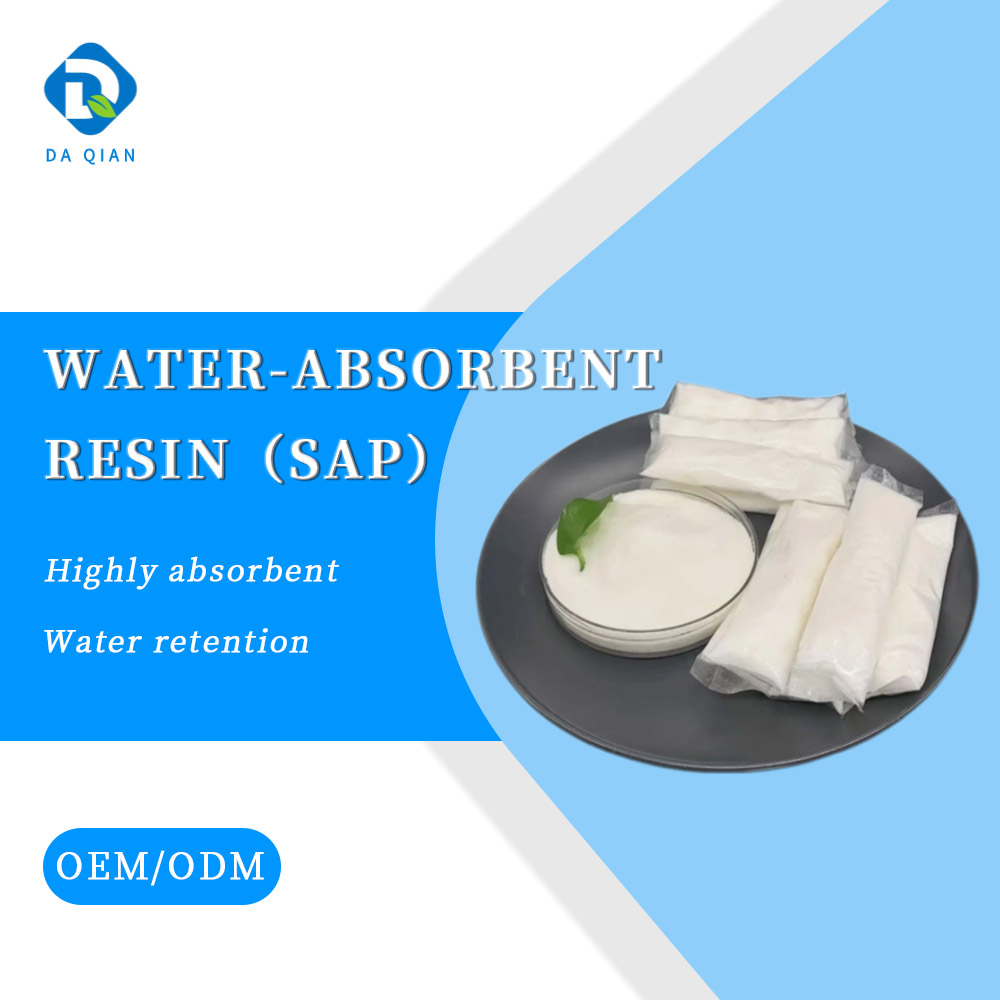
With the development of advanced polymer technology, Super Absorbent Polymer (SAP) has become an efficient functional absorbent material because of its high absorption capacity and excellent water-retention properties.
So, what makes SAP different from traditional absorbent materials?
1. Different Water Absorption Capacity
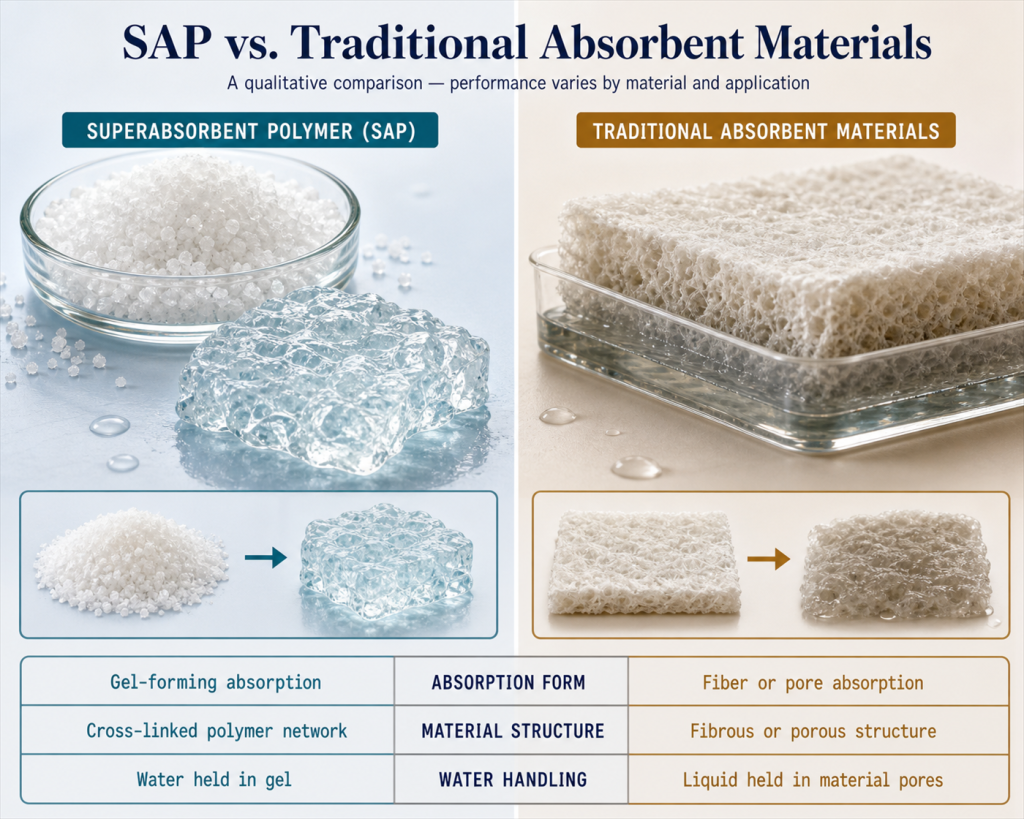
Traditional absorbent materials usually absorb liquid through their porous or fibrous structures.
SAP, on the other hand, absorbs and stores water through its three-dimensional polymer network.
Under suitable testing conditions, SAP can absorb many times its own weight in water, providing high liquid-holding capacity.
2. Different Water Retention
After absorbing liquid, some traditional absorbent materials may release part of the absorbed liquid under pressure.
SAP swells and forms a gel after absorbing water, helping lock the liquid inside its polymer network and providing better liquid retention.
3. Different Absorption Form
Traditional absorbent materials generally become wet or swollen after absorbing liquid.
SAP rapidly absorbs water and transforms into a swollen gel, helping immobilize the absorbed liquid.
4. Adjustable Performance
SAP can be designed or selected according to different application requirements, including:
- Water absorption capacity
- Absorption rate
- Gel strength
- Particle size
- Water retention
This flexibility allows different SAP grades to meet different liquid absorption and moisture-management requirements.
5. Choosing the Right Material Matters
SAP is not necessarily the best choice for every application.
Different applications have different requirements. When high absorption capacity, strong liquid retention, and stable gel formation are important, SAP can be an excellent option.
For simple liquid absorption needs, however, traditional absorbent materials may still be more economical and suitable.
Conclusion
The key difference between SAP and traditional absorbent materials is the combination of high absorption capacity and gel-based liquid retention.
Rather than simply choosing the material with the highest absorption capacity, it is better to evaluate absorption capacity, absorption rate, water retention, gel strength, and cost according to the actual application.
Choosing the right absorbent material means choosing the right balance of performance and application requirements.