Company News
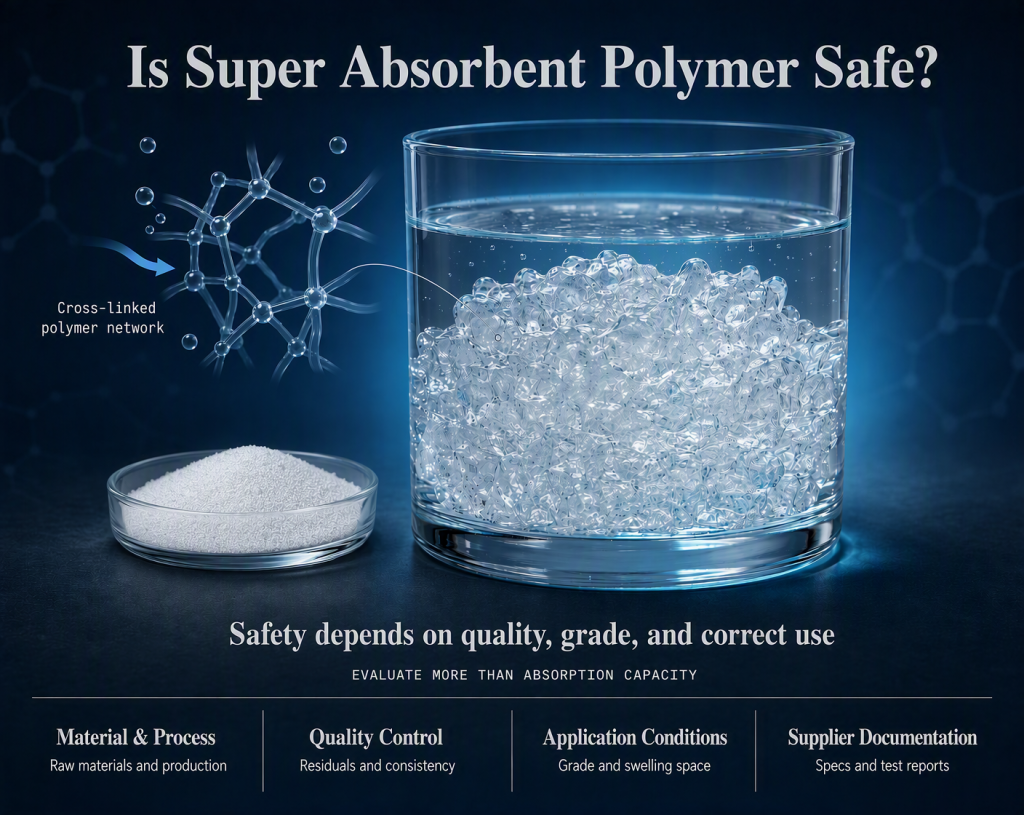
Is Super Absorbent Polymer Safe?
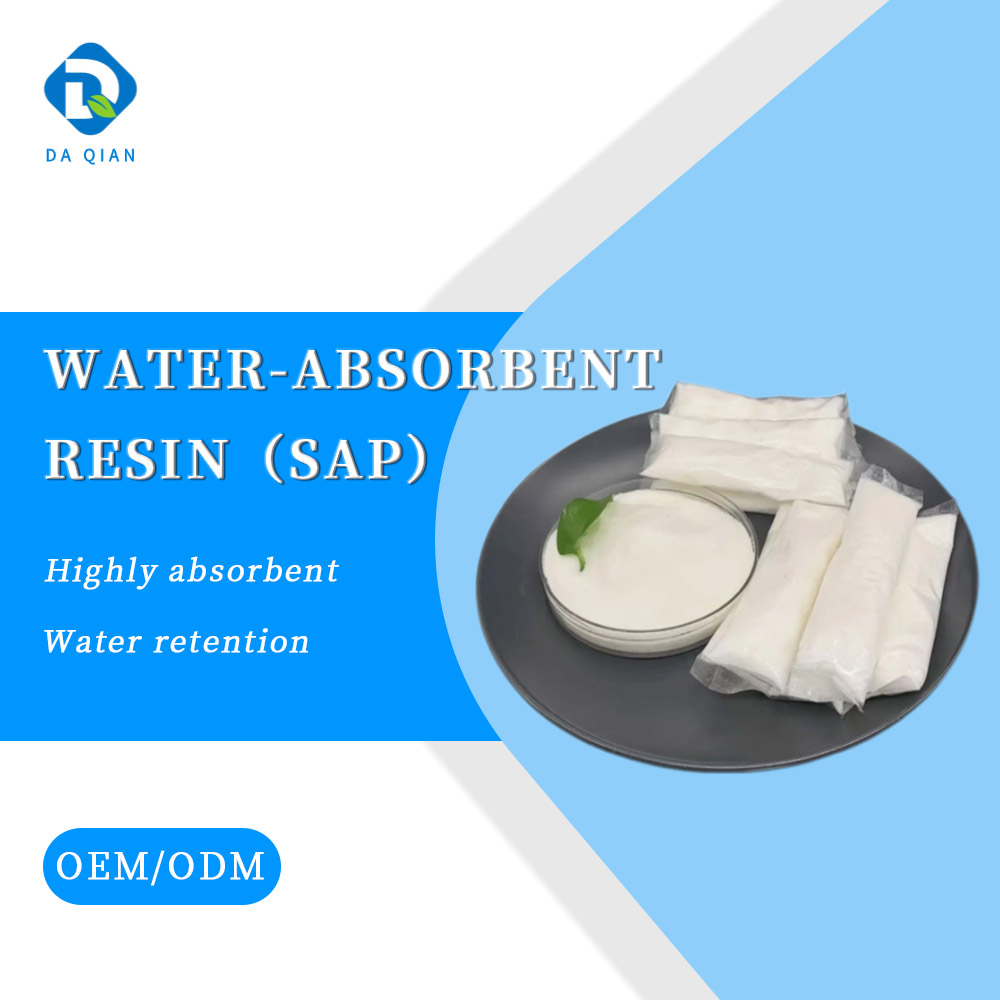
Super Absorbent Polymer (SAP) is a polymer material capable of absorbing and retaining large amounts of water. It is widely used in agriculture, landscaping, industrial absorbent materials, and moisture management.
So, is SAP safe?
In general, SAP that meets the appropriate quality and application requirements can offer good safety when used correctly. However, SAP safety depends on more than its water absorption performance. Raw materials, production processes, quality control, and application conditions should also be considered.
1. How Does SAP Work?
SAP is generally made from hydrophilic polymers with a cross-linked three-dimensional network structure.
When SAP comes into contact with water, water enters the polymer network and becomes trapped within the structure. The particles swell and form a gel, allowing SAP to store a large amount of water.
2. Is SAP Toxic?
High-quality SAP products generally have a stable cross-linked structure and do not dissolve in water like ordinary soluble chemicals under normal conditions.
However, SAP products for different applications may differ in terms of raw materials, manufacturing processes, residual substances, and quality requirements.
When purchasing SAP, it is important to ask suppliers for product specifications, test reports, and information about applicable safety and quality requirements.
3. Why Is Product Quality Important?
The safety and stability of SAP are closely related to its manufacturing process. Professional manufacturers should control key factors such as raw materials, polymerization, crosslinking, moisture content, particle size, and batch consistency.
When evaluating an SAP supplier, pay attention to:
- Chemical composition and technical specifications
- Key residual monomer indicators
- Product test reports
- Moisture content and particle size distribution
- Batch-to-batch consistency
- Intended application and product grade
High water absorption does not necessarily mean high quality. Safety, stability, and application performance are equally important.
4. What Should You Consider When Using SAP?
SAP is generally stable under normal application conditions, but the appropriate grade should always be selected according to the intended use.
Because SAP expands significantly after absorbing water, factors such as absorption capacity, swelling space, particle size, and application conditions should be considered.
For agricultural and industrial applications, SAP should be used according to the supplier’s technical specifications and recommended application conditions.
5. How Can You Choose a Reliable SAP?
When purchasing SAP, don’t only ask about its water absorption capacity. You should also evaluate:
Absorption Capacity + Absorption Rate + Gel Strength + Water Retention + Particle Size + Residual Indicators + Batch Consistency
Considering these factors together can help you determine whether a specific SAP grade is suitable for your application.
Conclusion
Is Super Absorbent Polymer safe?
When it meets appropriate quality requirements and is used correctly, SAP can generally be safely applied in its intended applications. However, safety and performance depend on raw materials, manufacturing processes, quality control, and actual application conditions.
Therefore, when selecting SAP, it is better to evaluate safety, quality consistency, and application performance together rather than focusing only on price or absorption capacity.
Looking for reliable SAP for your application? Contact us for product specifications, samples, and technical support.