Company News
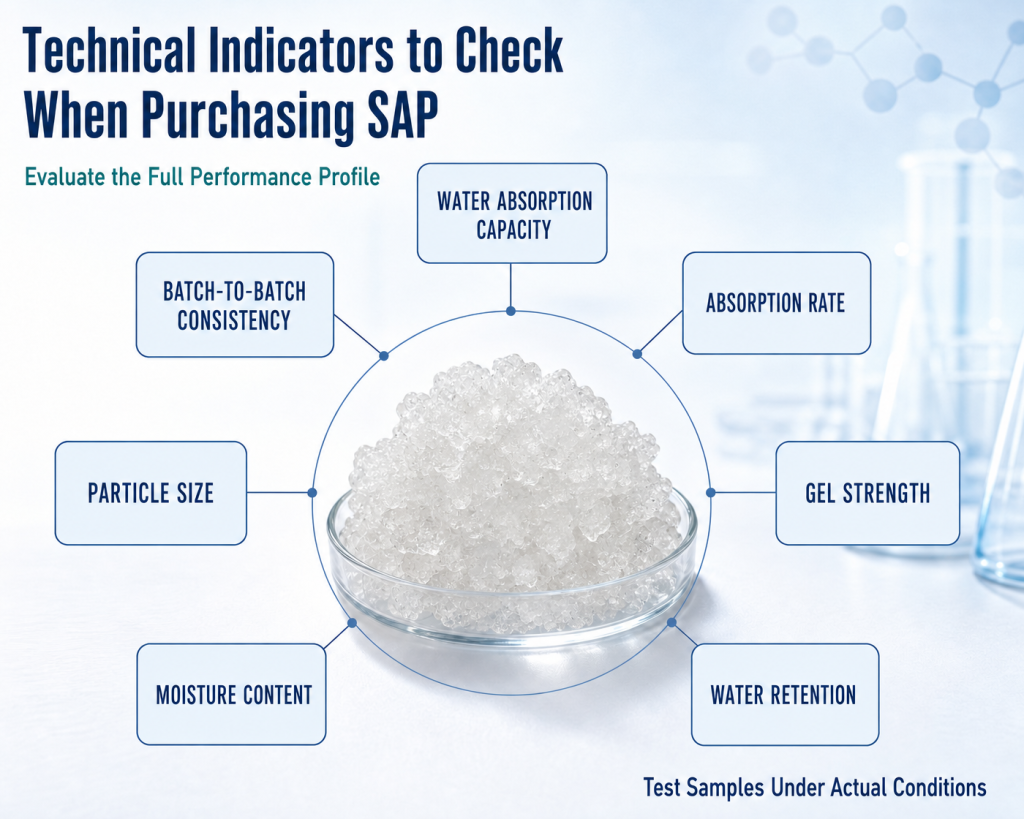
Key Technical Specifications to Consider When Purchasing SAP
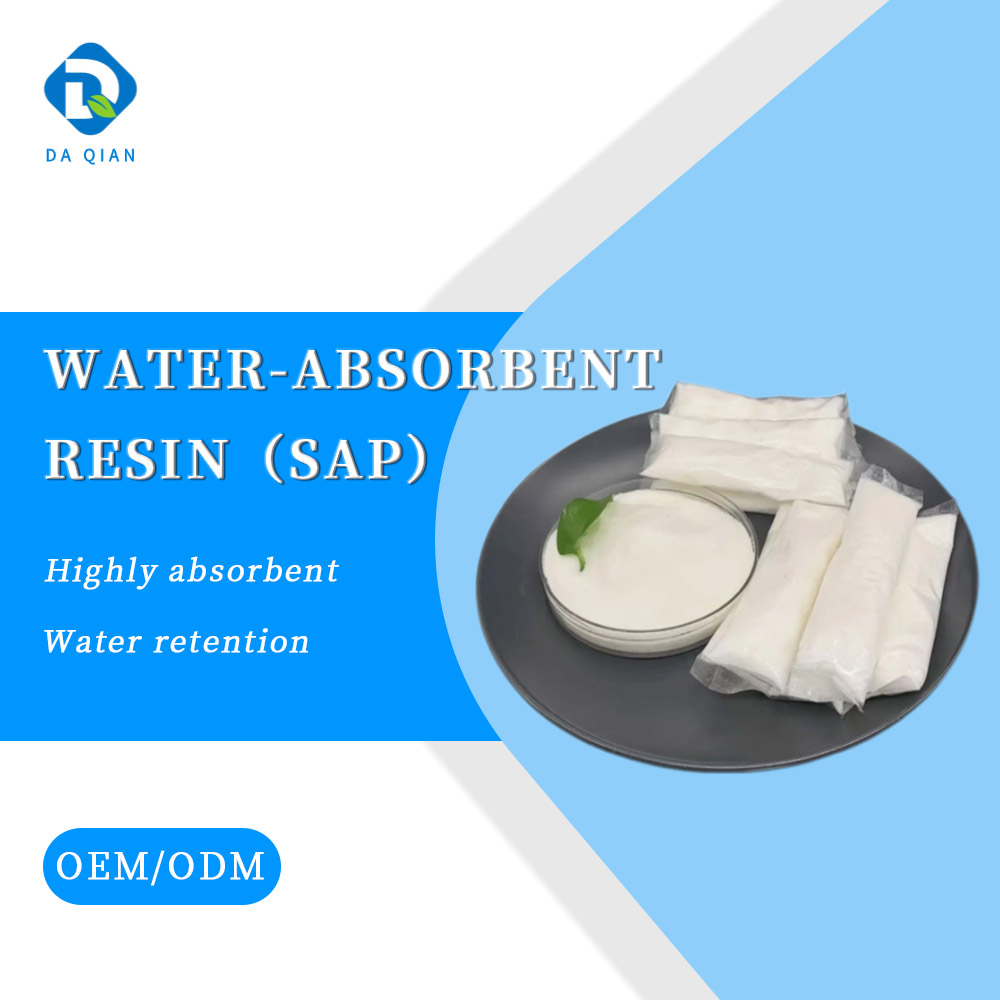
When purchasing Super Absorbent Polymer (SAP), buyers often focus first on price and water absorption capacity.
However, different applications require different SAP properties. Comparing only one specification is usually not enough to determine whether a product is suitable for actual use.
Before purchasing SAP, the following technical specifications should be considered.
1. Water Absorption Capacity
Water absorption capacity is one of the most common SAP performance indicators. It shows how much liquid the product can absorb under specific conditions.
However, different testing conditions can produce different results. For example, SAP may perform very differently in pure water and saline solutions.
Therefore, when comparing products, buyers should also confirm whether the testing liquid and testing method are the same.
2. Absorption Rate
Water absorption capacity answers the question:
“How much can it absorb?”
Absorption rate answers:
“How fast can it absorb?”
For applications requiring rapid liquid uptake, absorption rate can be just as important as final absorption capacity.
3. Gel Strength
SAP forms a gel after absorbing liquid.
Gel strength affects the stability of the swollen polymer and its ability to retain absorbed liquid. If the gel structure is too weak, it may affect application performance.
Therefore, gel performance should be evaluated according to the intended application.
4. Water Retention
SAP should not only absorb liquid but also retain it effectively.
Good water retention can help reduce liquid release after absorption and provide more stable performance during actual use.
5. Particle Size and Distribution
Particle size can affect absorption rate, dispersion, and processing performance.
A stable particle-size distribution can also help maintain consistency during manufacturing and application.
Different applications may require different particle-size specifications.
6. Moisture Content
Moisture content is another factor related to product storage and stability.
Proper moisture control can help maintain product quality during storage and reduce the risk of moisture-related problems such as caking.
7. Batch-to-Batch Consistency
For long-term purchasing, good performance from a single sample is not enough.
Buyers should also evaluate whether the supplier can maintain consistent product performance between different production batches.
Stable batch quality can help reduce production fluctuations and improve long-term reliability.
Don’t Focus on Only One Specification
When evaluating SAP, buyers should consider:
- Water Absorption Capacity
- Absorption Rate
- Gel Strength
- Water Retention
- Particle Size
- Moisture Content
- Batch-to-Batch Consistency
Different applications require different performance profiles.
The best SAP is not necessarily the product with the highest value for one specification. It is the product whose overall performance matches the actual application requirements.
Conclusion
When purchasing SAP, price and absorption capacity are important, but they do not tell the whole story.
By evaluating absorption capacity, absorption rate, gel strength, water retention, particle size, moisture content, and batch consistency, buyers can make a more informed purchasing decision.
Before placing a bulk order, it is recommended to test samples and evaluate performance under actual application conditions whenever possible.
Looking for stable and high-performance Super Absorbent Polymer? Contact us for product specifications, samples, and technical support.