Company News
Why Does SAP Absorb Less Water in Saline Water?
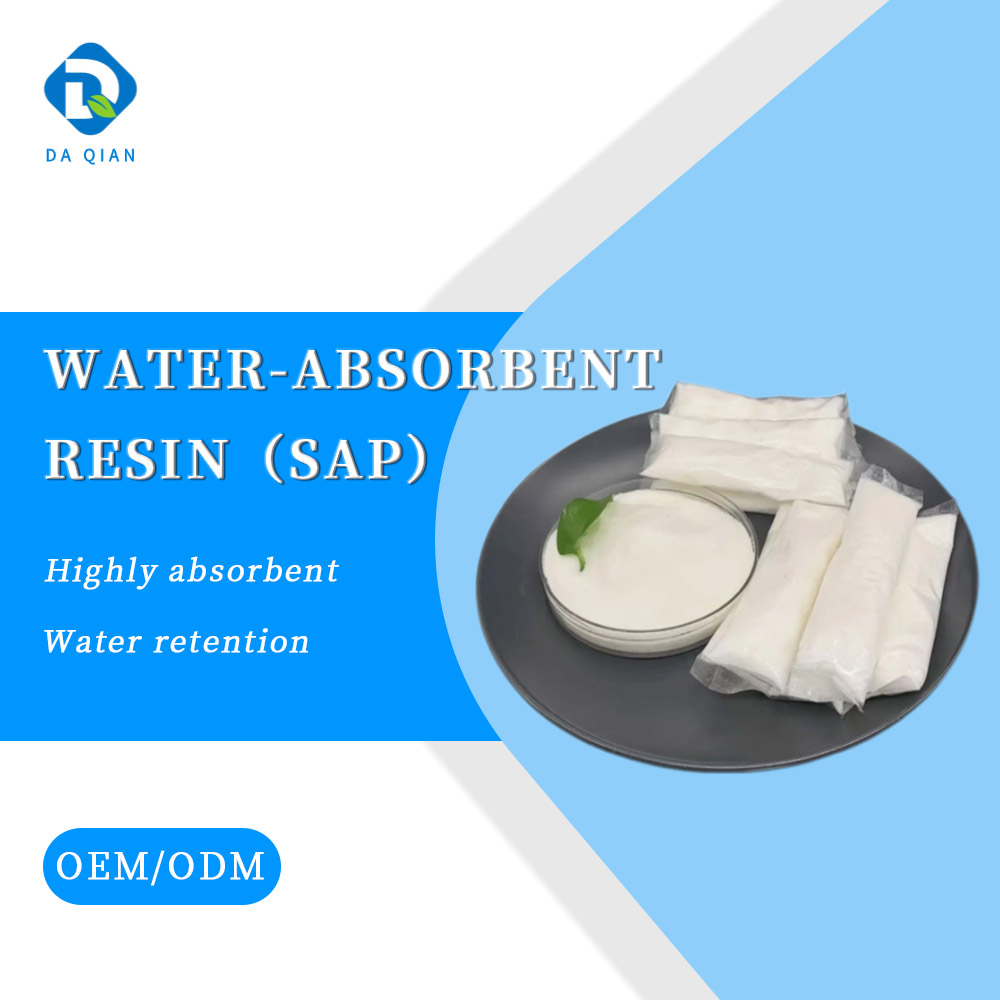
Super Absorbent Polymer (SAP) is known for its strong water absorption ability. However, users often notice that:
The same SAP usually absorbs much more water in pure water than in saline water.
So, why does this happen?
1. Dissolved Ions Affect Water Absorption
SAP contains hydrophilic groups that attract water molecules and allow the polymer network to swell.
In pure water, the difference in ion concentration between the SAP network and the surrounding water helps drive water into the polymer.
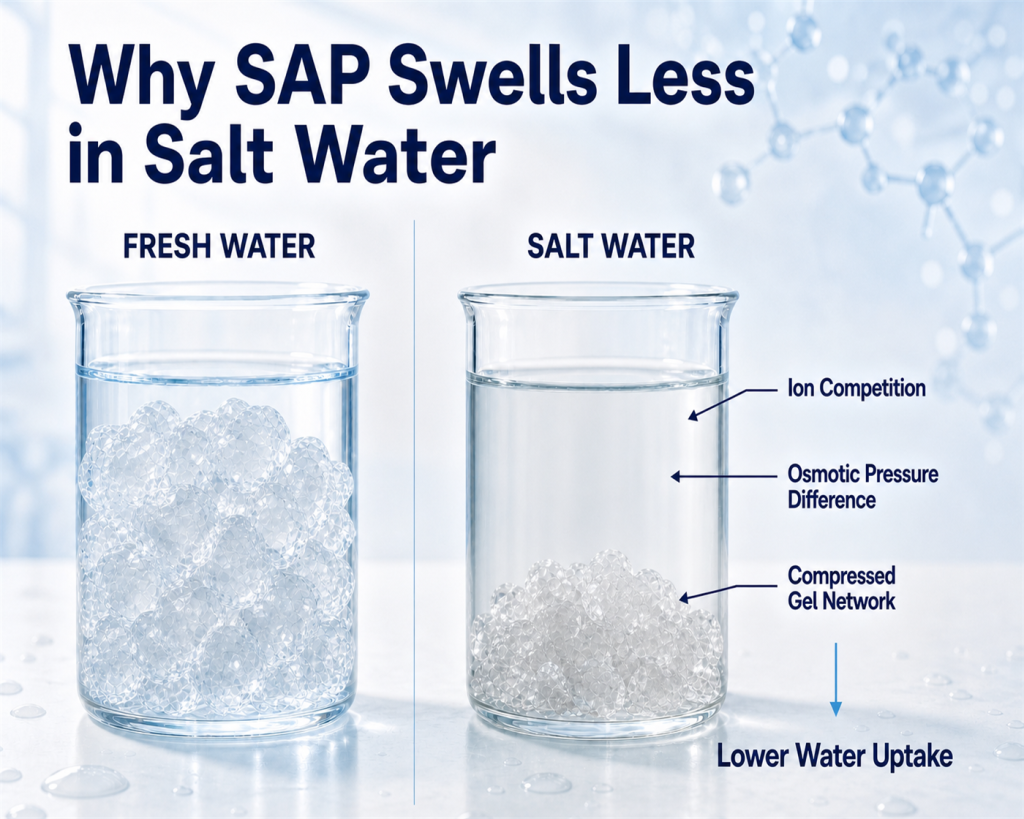
In saline water, dissolved ions such as sodium, potassium, and chloride reduce this driving force, resulting in lower water absorption.
2. Lower Osmotic Driving Force
SAP swelling is strongly influenced by the osmotic pressure difference between the polymer network and the surrounding liquid.
In pure water, this difference is greater, allowing SAP to absorb and swell more easily.
As salt concentration increases, the difference becomes smaller, and less water enters the SAP network.
3. Salt Ions Can Limit Swelling
Higher concentrations of dissolved ions can also affect the polymer network and limit how much SAP can expand.
In general:
Higher salt concentration can lead to lower water absorption capacity.
Different Salt Solutions Can Have Different Effects
The impact on SAP may vary depending on the type of salt, ion concentration, and water quality.
Therefore, if SAP is used with saline water, groundwater, or other complex liquids, pure-water absorption data should not be the only reference.
Conclusion
SAP absorbs less water in saline solutions mainly because dissolved ions reduce the osmotic driving force and limit polymer swelling.
Therefore:
Pure Water Absorption Capacity ≠ Saline Water Absorption Capacity
For accurate product selection, SAP should ideally be tested under actual application conditions.
Looking for SAP suitable for different water conditions? Contact us for product specifications, samples, and technical support.