Company News
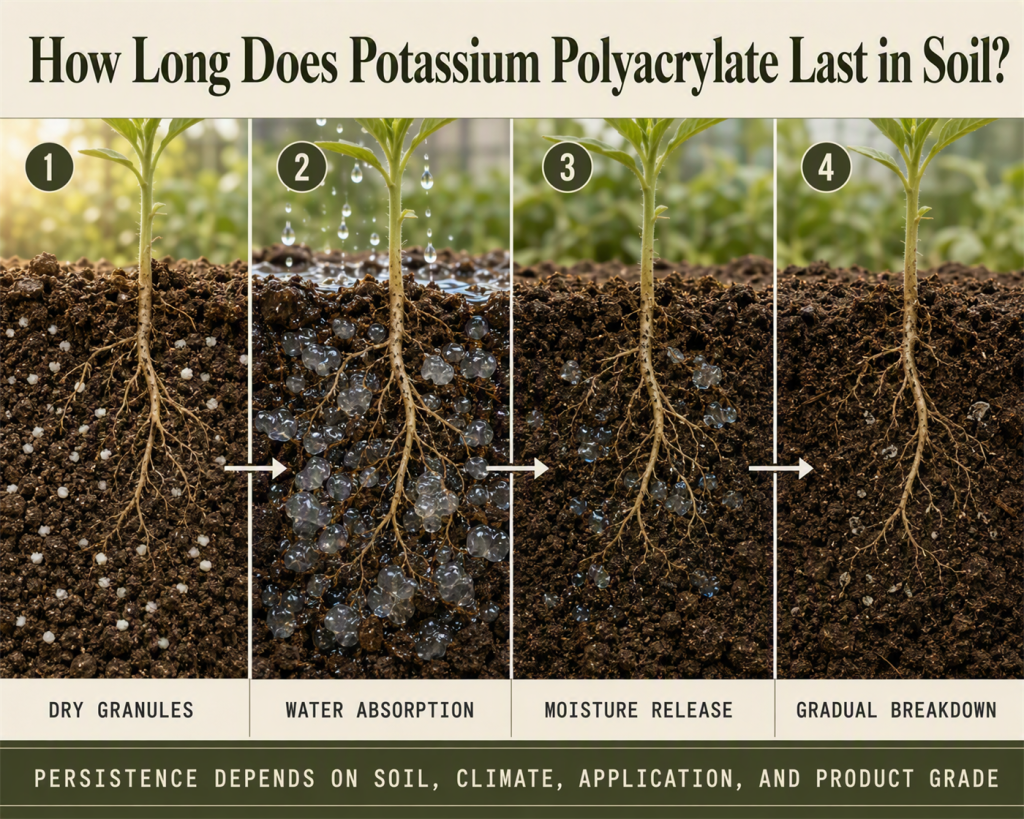
How Long Does Potassium Polyacrylate Last in Soil?
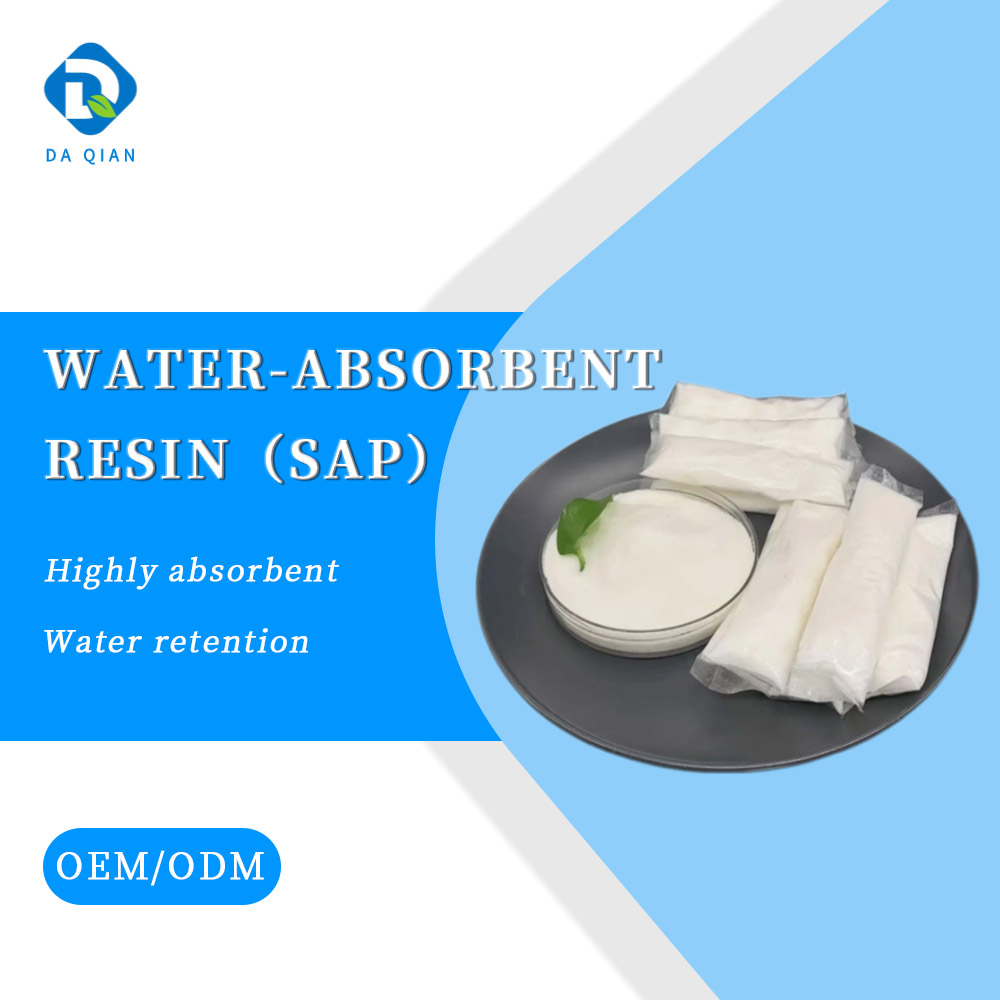
Potassium Polyacrylate is a water-retaining polymer widely used in agriculture, horticulture, landscaping, and soil moisture management. It can absorb and store water when sufficient moisture is available, then gradually release it to the surrounding soil as the soil becomes dry.
But how long can potassium polyacrylate remain effective in soil?
How Long Does It Last?
Under suitable soil conditions, potassium polyacrylate can typically remain effective for several growing seasons. However, its actual service life varies depending on the application environment.
Several factors can affect its performance:
- Soil type: Different soils can affect polymer stability and water absorption.
- Temperature and sunlight: High temperatures and prolonged exposure to sunlight may accelerate degradation.
- Water and rainfall: Frequent irrigation and heavy rainfall can affect its performance over time.
- Microbial activity: Natural microorganisms in soil can gradually break down the polymer.
- Application method: Proper mixing and suitable application rates can help maintain its effectiveness.
Rather than focusing on a fixed number of years, it is better to evaluate the polymer based on its water absorption capacity and soil moisture retention performance.
How Does Potassium Polyacrylate Work in Soil?
After irrigation or rainfall, potassium polyacrylate absorbs a large amount of water and expands into a gel-like material. When the surrounding soil becomes dry, the stored water can gradually be released.
This repeated absorption–storage–release cycle helps improve soil moisture management and can reduce the frequency of irrigation.
How to Extend Its Effectiveness?
Proper application can help maximize the service life of potassium polyacrylate:
- Apply it near the plant root zone.
- Mix it evenly with the soil.
- Avoid excessive exposure to direct sunlight.
- Select the appropriate particle size and dosage.
- Adjust the application according to soil and crop conditions.
Conclusion
Potassium polyacrylate does not have one fixed lifespan in soil. Its effectiveness can last through multiple growing seasons, depending on soil conditions, climate, irrigation, and application methods.
With proper selection and application, potassium polyacrylate can provide long-lasting water retention and help improve soil moisture management for agricultural and horticultural applications.
Looking for potassium polyacrylate for agriculture or soil water retention? Contact us for product specifications and customized solutions.