Company News
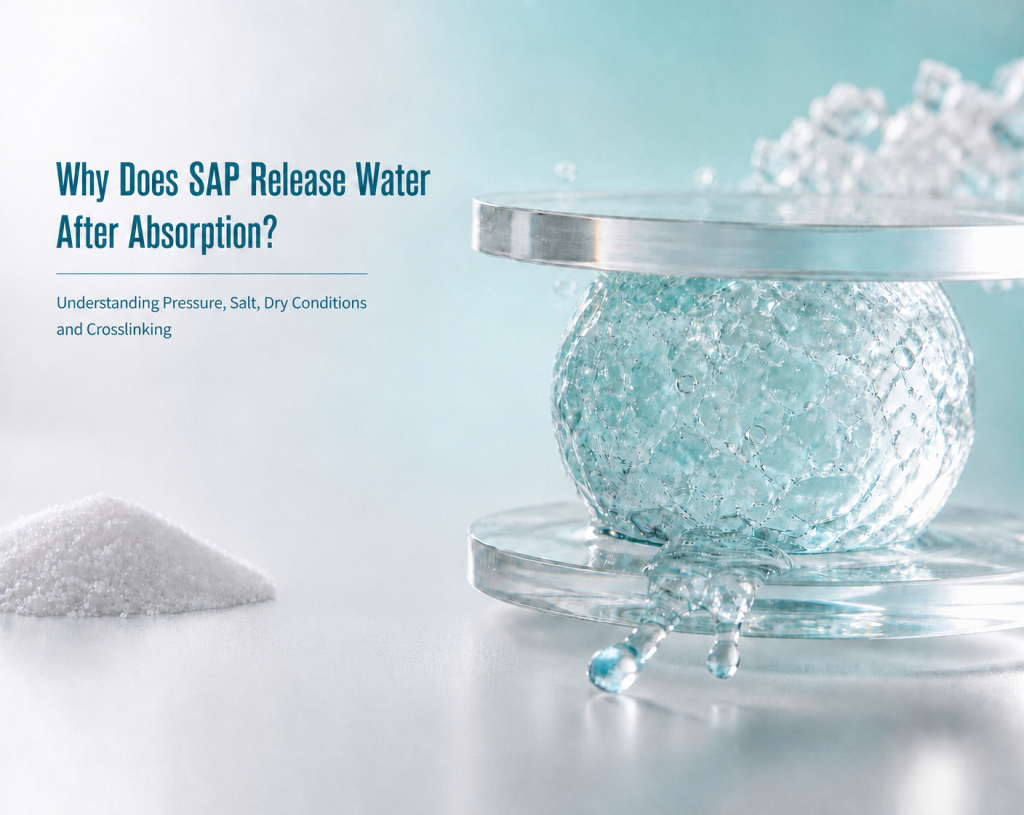
Why Does SAP Release Water After Absorption?
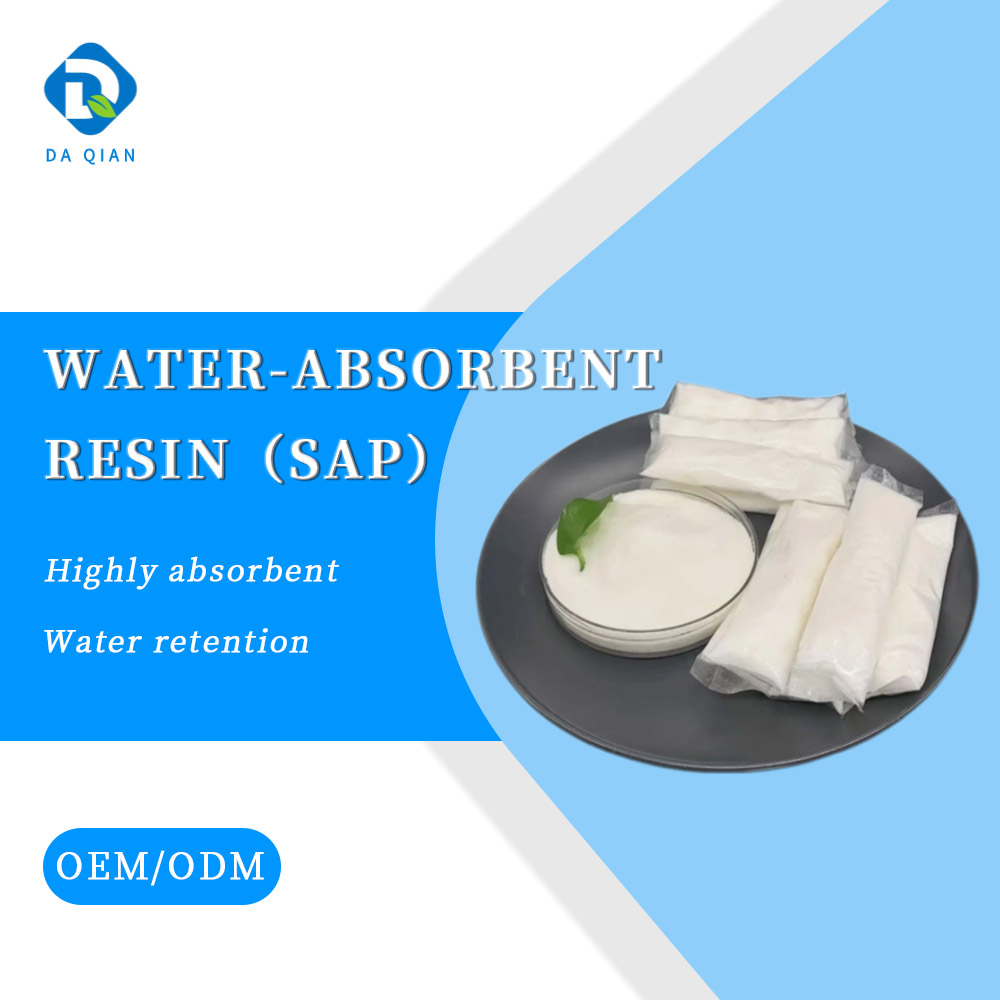
Super Absorbent Polymer (SAP) is known for its high water absorption and retention capacity. However, in practical applications, SAP may sometimes release part of the absorbed water after swelling.
This does not necessarily mean that the SAP has failed. The phenomenon can be related to external pressure, salt concentration, water quality, environmental conditions, and polymer structure.
1. External Pressure Can Release Water
After absorbing water, SAP swells and forms a gel. When the gel is compressed or subjected to mechanical pressure, its structure may deform and release part of the absorbed water.
Therefore, the actual water retention performance of SAP under pressure may differ from its free-swelling absorption performance measured in laboratory tests.
2. Salt Can Reduce Water Retention
SAP is sensitive to water quality. It generally absorbs more water in pure water, while the presence of salts and other ions can reduce its absorption capacity.
Salt ions reduce the osmotic pressure difference between the inside and outside of the polymer network, limiting swelling and potentially causing some absorbed water to be released.
This is why water absorption measured in pure water does not always represent performance under real application conditions.
3. Dry Conditions Can Cause Gradual Water Release
When the surrounding environment becomes dry, water contained in the SAP gel can gradually migrate out and evaporate.
In agricultural and landscaping applications, SAP is not designed to lock water permanently. Instead, it absorbs, stores, and gradually releases water to help improve water availability.
4. Crosslinking Affects Water Retention
The degree of crosslinking has an important influence on both water absorption and gel strength.
SAP with lower crosslinking may have higher swelling capacity but relatively lower gel strength, making it more susceptible to water release under pressure or certain conditions.
SAP with higher crosslinking generally forms a stronger gel structure, but its swelling capacity may be reduced to some extent.
Therefore, the highest absorption capacity is not always the best choice. The right balance between absorption capacity and gel strength is important.
5. How Can You Improve SAP Water Retention?
When selecting SAP, don’t focus only on maximum absorption capacity. Also consider:
- Absorption rate
- Water retention
- Gel strength
- Crosslinking level
- Particle size
- Water quality and salt concentration
- Actual application conditions
The appropriate SAP grade should be selected according to the specific application environment.
Conclusion
Why does SAP release water after absorption?
Water release from SAP is usually the result of interactions between the polymer and its surrounding environment. It does not necessarily indicate a quality problem.
External pressure, salt concentration, dry conditions, and polymer crosslinking can all affect SAP’s water absorption and retention performance.
Therefore, when selecting SAP, it is better to evaluate the product under actual application conditions rather than comparing only laboratory absorption capacity.
Looking for the right SAP grade for your application? Contact us for product specifications, samples, and technical support.