Company News
Molecular Structure and Performance of Polyacrylamide
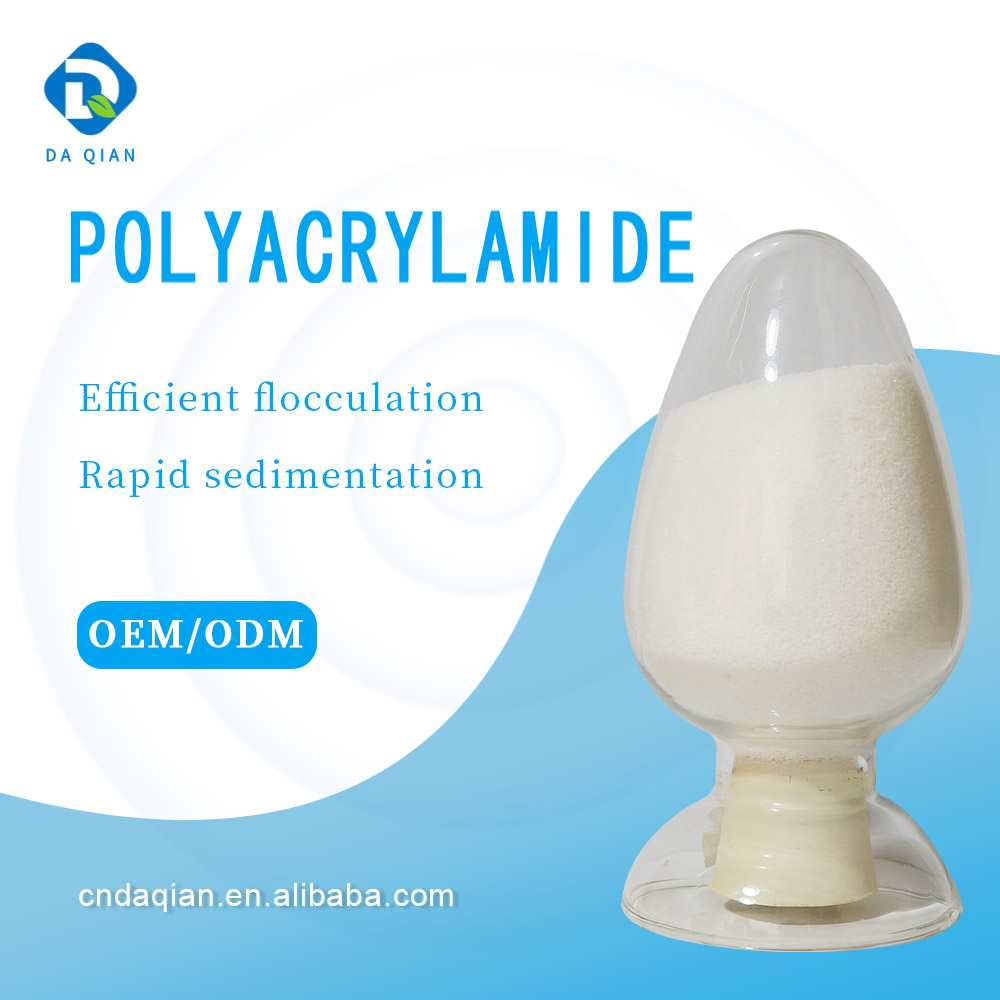
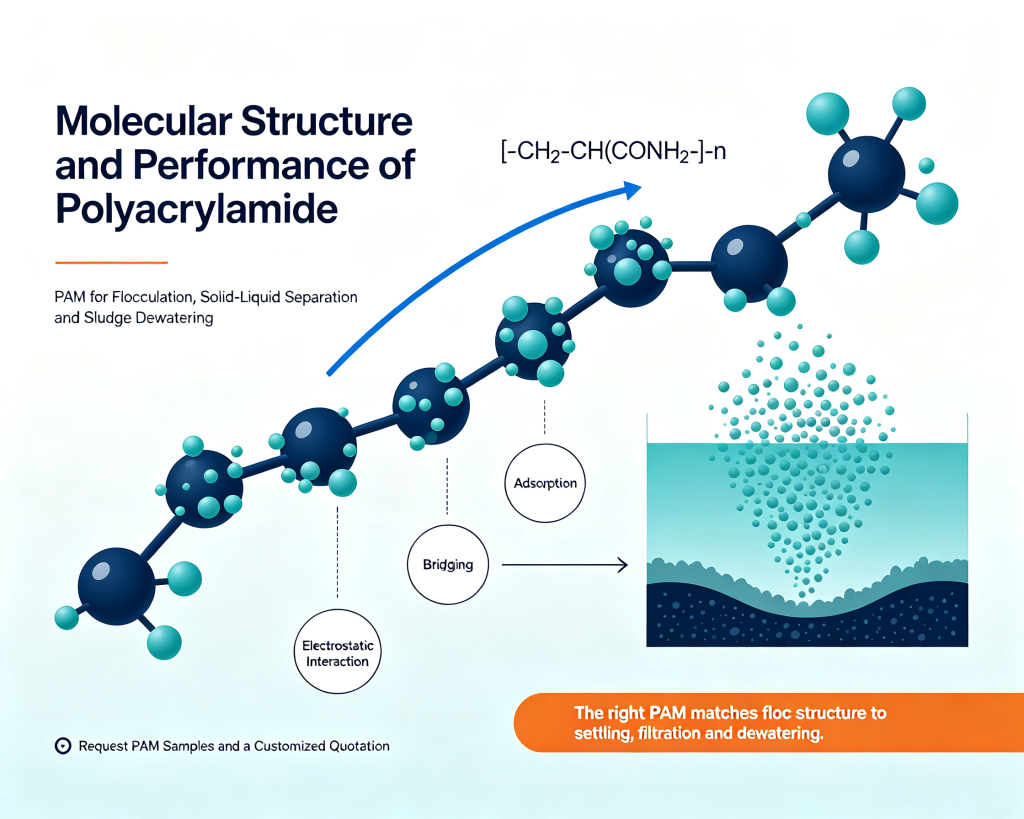
Polyacrylamide (PAM) is a water-soluble polymer widely used as a flocculant in wastewater treatment, sludge dewatering, papermaking, and mineral processing. Its basic repeating structure is [-CH2-CH(CONH2)-]n. Through copolymerization or modification, PAM can be produced in anionic, cationic, nonionic, or amphoteric forms.
PAM promotes flocculation through adsorption, polymer bridging, and electrostatic interactions. It helps suspended solids, colloids, and sludge particles aggregate into larger flocs. However, PAM performance depends not only on whether flocs are formed, but also on molecular weight, charge density, dissolution conditions, and dosage. These factors affect floc size, strength, settling, filtration, and sludge dewatering.
Molecular Weight and Bridging Ability
Molecular weight affects polymer chain length and bridging ability. Longer polymer chains can connect more particles and may help form larger flocs. However, an excessively high molecular weight may result in slower dissolution, higher solution viscosity, and more difficult transfer and dosing.
Therefore, the highest molecular weight is not always the best choice. The suitable molecular weight should be selected according to particle characteristics, sludge type, equipment conditions, and the treatment objective.
Charge Type and Adsorption Performance
The charge type of PAM affects its interaction with particle and sludge surfaces. Anionic PAM is commonly used for solid-liquid separation in mining, mineral processing, coal washing, sand washing, and selected industrial wastewater applications. Cationic PAM is widely used for municipal sludge, activated sludge, food-processing sludge, and papermaking sludge dewatering.
Nonionic and amphoteric PAM may be suitable for special water qualities or complex processes. Different wastewater requires a suitable charge type and charge density, so PAM should not be selected by product name alone.
Charge Density and Flocculation Performance
Charge density affects PAM adsorption and electrostatic interactions between particles. If the charge density is too low, particle aggregation may be insufficient. If it is too high, adsorption compatibility may be reduced, affecting floc structure and stability.
For anionic PAM, the degree of hydrolysis also affects charge characteristics and flocculation behavior. In practical applications, pH, salinity, suspended solids, and upstream coagulants should be considered together.
How Does PAM Affect Solid-Liquid Separation?
A suitable PAM can help form flocs with appropriate size, density, and strength, improving sedimentation, filtration, and sludge dewatering. However, flocs that are too large, too loose, or excessively sticky may affect the following treatment process.
During settling, filtration, and mechanical dewatering, flocs are exposed to water flow, mixing, and shear forces. Weak flocs may break apart and release fine particles back into the water. A suitable floc structure can maintain aggregation and support more effective water separation from sludge.
How to Select the Right PAM?
No single PAM grade is suitable for every project. Before selection, provide the flow rate and water or sludge information. Jar tests or field trials can then be used to compare:
- Floc size and density;
- Settling speed;
- Supernatant clarity;
- Sludge dewatering performance;
- Cake moisture;
- Polymer consumption.
These results help determine the suitable PAM type, molecular weight, charge density, and dosage.
Conclusion
The role of PAM is not simply to form flocs. More importantly, it helps create a floc structure suitable for the subsequent sedimentation, filtration, or dewatering process. When selecting PAM, it is important to consider not only price or individual specifications, but also actual flocculation performance, floc strength, and operating stability.
Looking for the right PAM grade for your wastewater treatment process? Contact us for samples, product specifications, technical support, and a customized quotation.
Request PAM Samples and a Customized Quotation