Company News
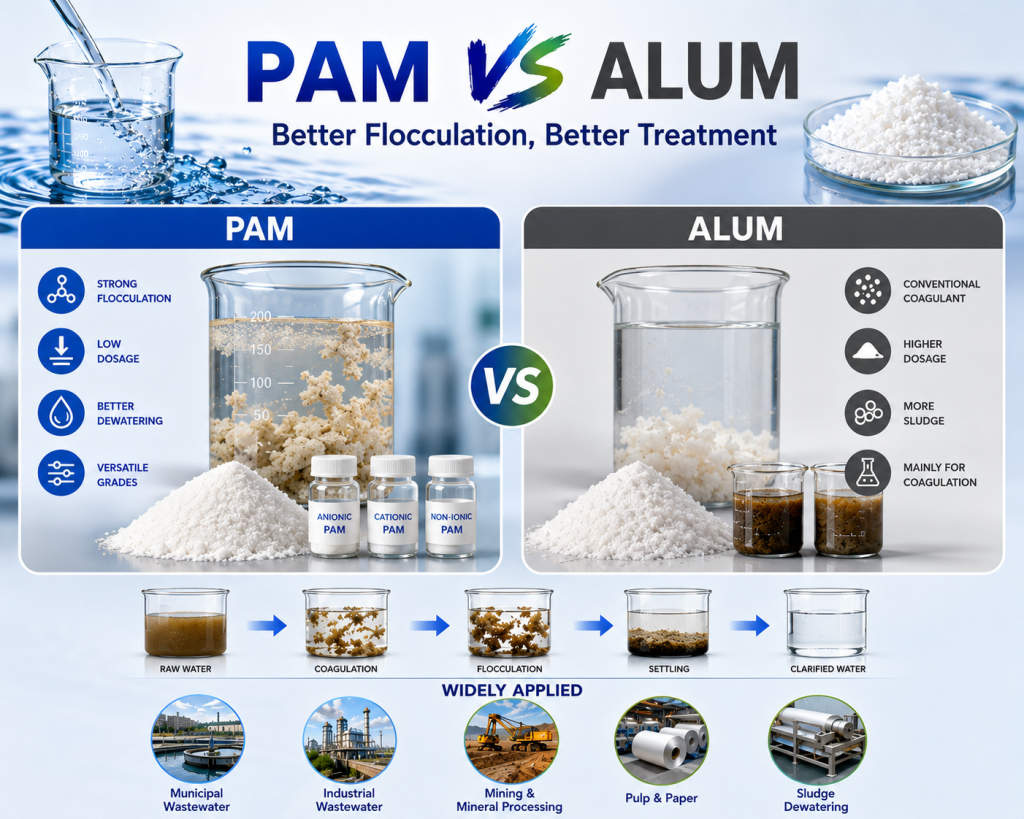
PAM vs Alum: Why Choose Polyacrylamide for Wastewater Treatment?
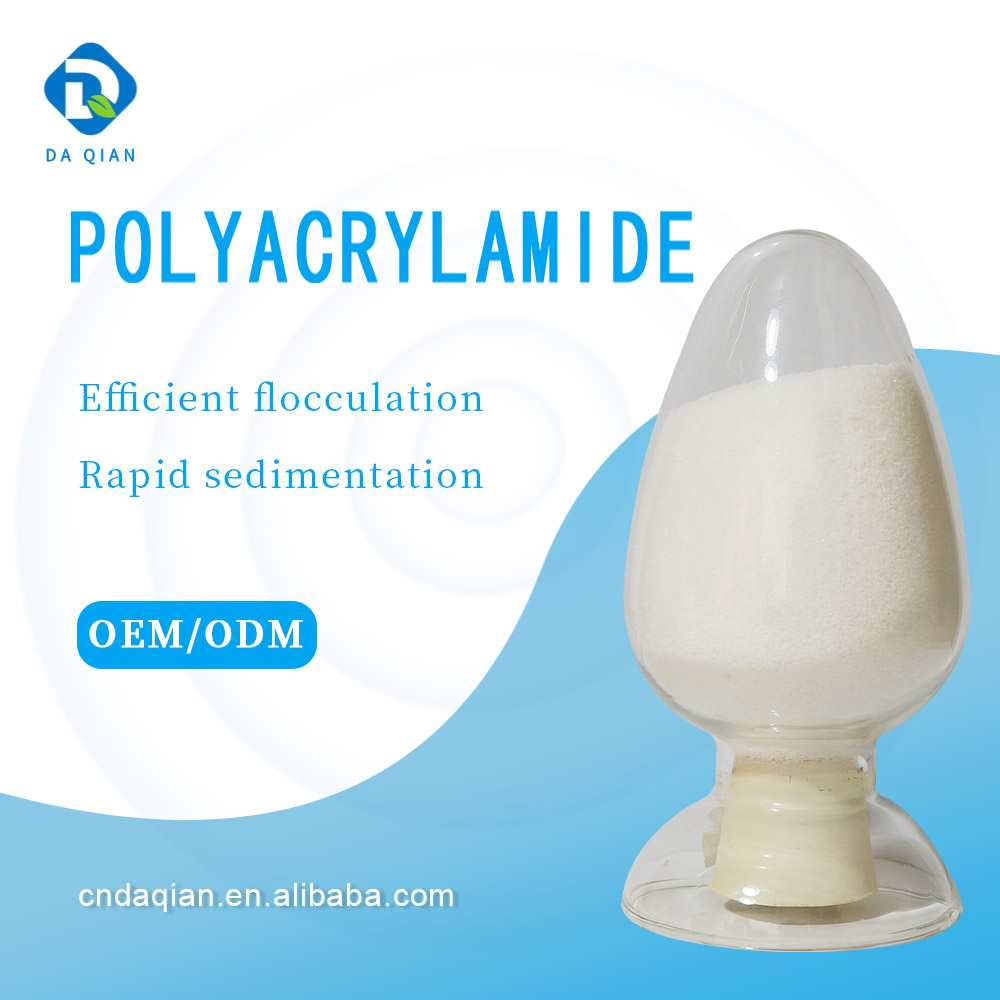
In wastewater treatment, Alum is a traditional inorganic coagulant, while PAM (Polyacrylamide) is a polymer flocculant widely used in industrial wastewater, municipal wastewater, mining wastewater, and sludge dewatering applications.
With its strong flocculation performance, relatively low dosage, and versatility, PAM has become an important chemical in many modern water treatment processes.
🔹 1. Excellent Flocculation Performance
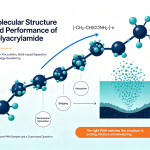
PAM mainly works through adsorption and bridging, connecting fine suspended particles and bringing them together to form larger flocs.
Larger flocs are generally easier to settle and can improve downstream processes such as flotation, filtration, and solid-liquid separation.
🔹 2. Low Dosage & High Efficiency
Under suitable water quality and process conditions, PAM can achieve effective flocculation at a relatively low dosage.
Selecting the appropriate molecular weight, charge type, PAM grade, and dosage can help improve treatment performance while optimizing chemical consumption and operating costs.
🔹 3. Excellent Sludge Dewatering Performance
PAM is not only used for suspended solids removal. It is also widely used in sludge dewatering.
A properly selected PAM can promote sludge particle aggregation and form stronger, more compact flocs, helping improve the performance of filter presses, centrifuges, belt filter presses, and other dewatering equipment.
For wastewater treatment plants that generate large amounts of sludge, the right PAM can help optimize the overall sludge treatment process and improve operational efficiency.
🔹 4. Different Grades for Different Water Qualities
Different wastewater characteristics require different PAM grades.
Anionic PAM
Commonly used in mining, sand washing, mineral processing, construction-related wastewater, and various industrial applications.
Cationic PAM
Widely used in municipal wastewater treatment, sludge dewatering, papermaking, and related applications.
Non-ionic PAM
Suitable for certain industrial wastewater and specific water quality conditions.
👉 There is no single PAM grade that works best for every wastewater application. Proper product selection is the key to achieving good treatment performance.
🔹 Can PAM Be Used Together with Alum?
Yes.
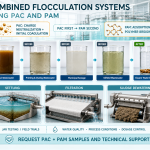
In many wastewater treatment processes, Alum or other inorganic coagulants can provide primary coagulation, while PAM further strengthens floc formation through adsorption and bridging.
The combination can produce more stable flocs and improve downstream solid-liquid separation.
Therefore, PAM does not simply have to “replace Alum.” Depending on the wastewater and treatment process, PAM can be used independently or together with inorganic coagulants.
🔹 Proper PAM Selection Makes the Difference
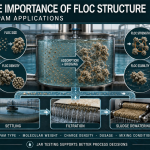
PAM performance can be affected by many factors, including water quality, pH, suspended solids characteristics, sludge type, molecular weight, charge density, and dosage.
That is why we recommend conducting a Jar Test before full-scale application to identify the most suitable PAM grade and dosage for each specific wastewater treatment process.
The right PAM is more than just a flocculant. It can help improve solid-liquid separation, optimize chemical consumption, and support more stable and efficient wastewater treatment.
📩 Looking for the right PAM / Polyacrylamide for your wastewater treatment project? Contact us for product information and grade selection recommendations.